How to Become an IAS/IPS Officer After Passing the 12th Class?
Becoming an IAS (Indian Administrative Service) or IPS (Indian Police Service) officer is a dream for millions of students in India. If you have just passed your 12th class, this is the perfect time to start planning your journey. While you cannot become an IAS or IPS officer immediately after Class 12, you can take the right steps that will prepare you for success in the future.
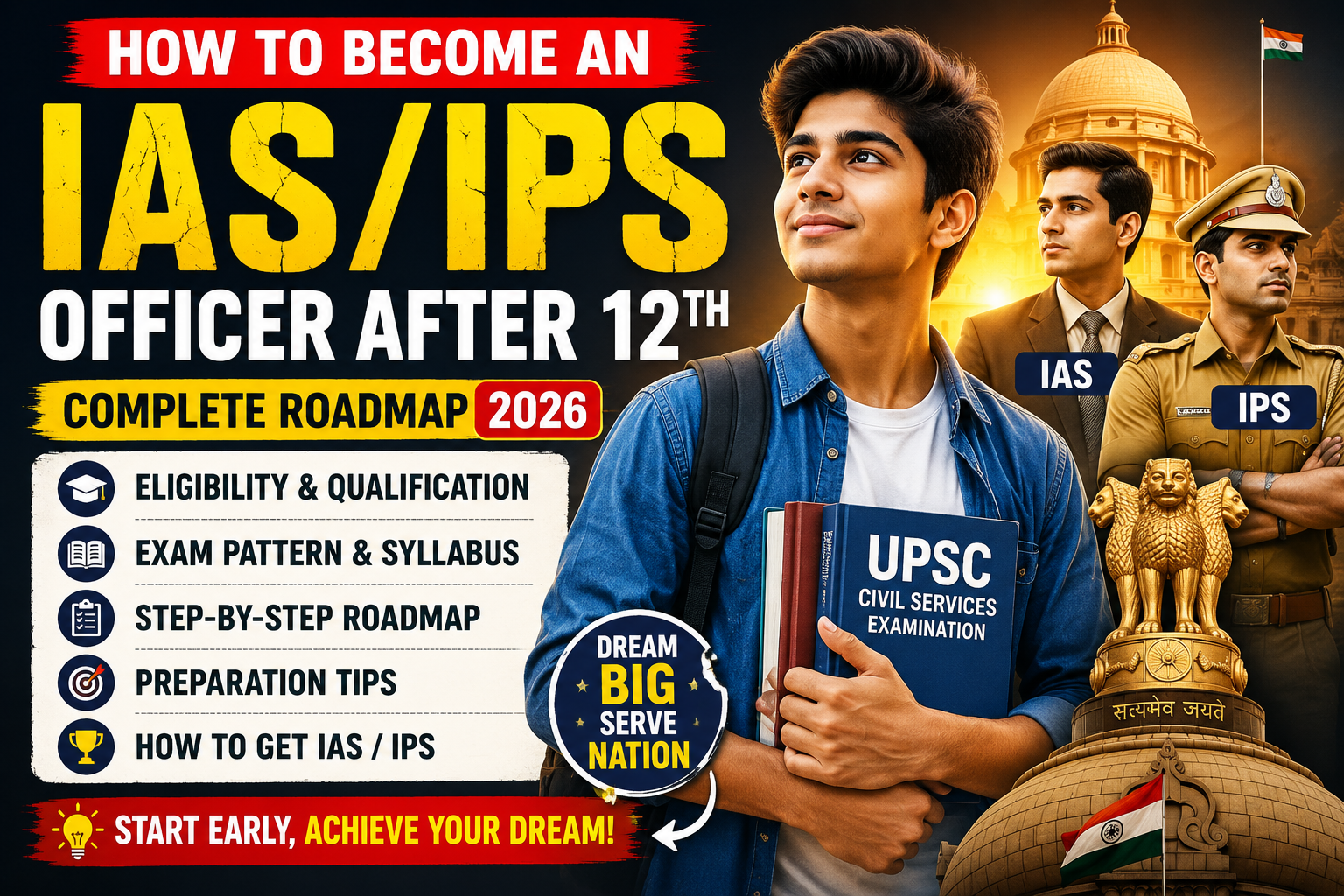
In this article, you’ll learn the complete roadmap—from choosing the right graduation course to clearing the UPSC Civil Services Examination.
Can You Become an IAS/IPS Officer Directly After 12th?
No. The Union Public Service Commission (UPSC) requires candidates to hold a bachelor’s degree from a recognized university before they are eligible to appear for the Civil Services Examination (CSE).
However, passing Class 12 is the first important milestone. The decisions you make after school can significantly improve your chances of becoming an IAS or IPS officer.
Step 1: Complete Your Graduation
After Class 12, enroll in a bachelor’s degree program from a recognized university.
Popular graduation courses include:
- BA (Bachelor of Arts)
- BSc (Bachelor of Science)
- BCom (Bachelor of Commerce)
- BTech/BE
- MBBS
- BBA
- Any other recognized bachelor’s degree
Important: UPSC does not give preference to any particular degree. Choose a subject that genuinely interests you and in which you can score well.
Step 2: Understand UPSC Eligibility
To appear for the UPSC Civil Services Examination, candidates generally need to meet these requirements:
Educational Qualification
- Bachelor’s degree from a recognized university.
Nationality
For IAS and IPS, the candidate must be an Indian citizen.
Age Limit (General Category)
- Minimum: 21 years
- Maximum: 32 years
Age relaxations are available for reserved categories according to government rules.
Step 3: Choose the Right Optional Subject
Although the UPSC exam includes an optional subject in the Mains examination, you don’t need to study the same subject in graduation.
Choose an optional based on:
- Your interest
- Availability of study material
- Previous success rate
- Your academic background
Step 4: Start Preparing Early
Students who begin preparation during graduation often have an advantage.
Focus on:
- Reading newspapers daily
- Improving English and writing skills
- Learning current affairs
- Studying Indian Polity
- Understanding History and Geography
- Learning basic Economics
- Developing analytical thinking
Step 5: Know the UPSC Exam Pattern
The UPSC Civil Services Examination has three stages.
Stage 1: Preliminary Examination
Two objective papers:
- General Studies Paper I
- CSAT (Qualifying)
This stage is used for screening candidates.
Stage 2: Main Examination
The Mains examination consists of descriptive papers including:
- Essay
- General Studies Papers
- Optional Subject Papers
- English (Qualifying)
- Indian Language (Qualifying)
Good writing skills are extremely important.
Stage 3: Personality Test (Interview)
Candidates who qualify the Mains appear for the UPSC Interview.
The board evaluates:
- Personality
- Decision-making ability
- Leadership qualities
- Communication skills
- Awareness of national and international issues
Step 6: Get a Good Rank
After the interview, UPSC prepares the final merit list.
Your rank determines whether you are allotted services such as:
- Indian Administrative Service (IAS)
- Indian Police Service (IPS)
- Indian Foreign Service (IFS)
- Indian Revenue Service (IRS)
- Other Central Civil Services
Higher ranks generally improve the chances of getting IAS or IPS.
Best Books for Beginners
Students starting after Class 12 can begin with:
- NCERT Books (Class 6–12)
- Indian Polity by M. Laxmikanth
- Modern History by Spectrum
- Certificate Physical and Human Geography by G.C. Leong
- NCERT Economics Books
- Current Affairs Magazine
- Daily Newspaper
Skills Every Future IAS/IPS Officer Should Develop
Success in UPSC depends on more than just studying.
Develop these skills:
- Time management
- Discipline
- Critical thinking
- Writing practice
- Public speaking
- Decision-making
- Leadership
- Problem-solving
Suggested Timeline After Class 12
Year 1
- Start graduation
- Read newspapers daily
- Complete NCERT books
Year 2
- Begin standard UPSC books
- Make short notes
- Improve answer-writing skills
Year 3
- Complete the UPSC syllabus
- Practice mock tests
- Revise regularly
Final Year / After Graduation
- Apply for UPSC Civil Services Examination
- Appear for Prelims
- Prepare for Mains and Interview
Common Mistakes to Avoid
- Waiting until graduation is over to start preparation.
- Ignoring current affairs.
- Studying without a proper timetable.
- Depending only on coaching.
- Skipping answer-writing practice.
- Not revising regularly.
Frequently Asked Questions (FAQs)
Can I become an IAS officer immediately after 12th?
No. You must first complete a bachelor’s degree from a recognized university.
Which stream is best after Class 12?
Any stream—Arts, Science, or Commerce—can lead to IAS or IPS. Choose one based on your interests and strengths.
Is coaching compulsory for UPSC?
No. Many successful candidates prepare through self-study using quality books, online resources, and consistent practice.
What is the minimum age for the UPSC Civil Services Examination?
The minimum age is generally 21 years.
Which degree is best for IAS preparation?
There is no “best” degree. Many aspirants choose BA because its subjects often overlap with the UPSC syllabus, but candidates from Science, Commerce, Engineering, and other backgrounds also succeed.
Conclusion
Your journey to becoming an IAS or IPS officer starts the day you pass Class 12. While you cannot appear for the UPSC Civil Services Examination immediately, you can use your graduation years wisely by building a strong academic foundation, developing good study habits, and staying informed about current affairs.
Success in UPSC requires dedication, consistency, and patience. If you start early, study strategically, and remain disciplined, you can significantly improve your chances of achieving your dream of serving the nation as an IAS or IPS officer.
If you’d like, I can also optimize this article for Google SEO (Rank Math/Yoast) with keywords, meta title, meta description, FAQs in schema format, and a featured snippet section.